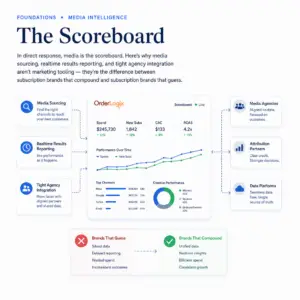




In direct response, media is the scoreboard. Every spot, every promo code, every URL, every daypart is a referendum on the offer. The brands that scale aren’t the ones with the cleverest creative. They’re the ones who can tie every dollar of media spend back to the exact source that produced the order — and then redeploy that spend before the window closes.
That’s the work that media sourcing, results reporting, and agency integration actually do. For direct response subscription companies, those three capabilities aren’t separate marketing tools. They’re a single discipline. Done well, they make media efficient, predictable, and compoundable. Done poorly, they make it expensive, opaque, and slow. This is the foundation article on why that discipline matters — and why an OMS that talks fluently to the agency is what makes it real.
The right audience at the right time
Media sourcing is the work of identifying, exactly, which channels actually move your customer — and getting in front of them when intent is highest. It’s harder than it used to be. Connected TV ad spend in the U.S. alone passed $30 billion in 2024 on its way toward $40 billion-plus, on top of the $250 billion-plus in U.S. internet advertising tracked by the IAB across digital channels.¹ ² That growth means more inventory, more targeting options, and more places to waste money.
Working with media agencies leverages expertise on which platforms, networks, dayparts, and creative variants will actually convert your audience — and on how quickly to scale up the winners or pull back from the laggards. That last piece is critical for subscription brands. Media agencies can scale campaigns up or down in days based on what the data is saying. The flexibility is essential when offers turn over fast and consumer demand shifts mid-quarter.
Real-time, not next-quarter
Performance tracking is what makes the scoreboard real. Reporting tied to the order — every transaction carrying its source, campaign, agent, offer version, and upsell attach — turns marketing from an opinion contest into a math problem. Decisions stop being “what the agency thinks worked last week” and start being “what the data is telling us today.”
That speed is itself a moat. McKinsey’s research on data-driven organizations found they are 23 times more likely to acquire customers, six times more likely to retain them, and 19 times more likely to be profitable than peers without the same data discipline.³ The team that can reallocate from a low-ROI source to a high-ROI source by Tuesday compounds against a team that does it next Monday.
Enhanced analytics from media agencies layer in customer behavior, preferences, and engagement patterns the brand wouldn’t otherwise see. Cross-channel attribution, audience modeling, and creative testing tools that would be impractical to build in-house become available as part of the relationship — and feed straight into the same reporting layer the operations team is already using.
Buy smarter, not just bigger
Cost efficiency is where the agency relationship pays for itself most visibly. Agencies have access to bulk purchasing discounts, premium inventory, and rate negotiations that a direct buyer simply doesn’t. They also have the leverage to push back on the supply chain, which matters more than most brands realize. The Association of National Advertisers’ Programmatic Media Supply Chain Transparency Study found that only about 36 cents of every advertiser dollar reaches the consumer in programmatic display, with the rest absorbed by intermediaries, fees, and unmeasured supply-chain costs.⁴ That gap is exactly the kind of leakage a sophisticated agency relationship is built to close.
In practice, that means more reach for the same budget, fewer surprises in the invoicing, and better terms with the platforms that matter. For a subscription brand running tight CAC math, that compounding cost discipline is often the difference between a campaign that scales and one that doesn’t.
One voice across every channel
Brand consistency is the underrated benefit of working with a serious media partner. The same offer, the same disclosure, the same product story has to land cleanly whether it’s a 60-second DRTV spot, a 15-second pre-roll, a podcast read, an email, or a paid social variant. Inconsistencies aren’t just aesthetic — they erode trust, complicate compliance, and confuse the customer at exactly the moment you’re asking them to commit.
Working with a media partner that owns end-to-end consistency means messaging, offer math, and disclosure language stay coordinated across every channel and every flight. The brand experience the customer sees on TV at 9 p.m. matches the one they see on their phone at 10. That uniformity is how a campaign quietly turns into a brand.
What changes when the OMS talks to the agency
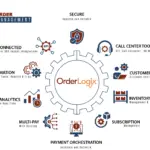
All of the above — sourcing, performance tracking, cost efficiency, analytics, brand consistency, scalability — only deliver their full upside when the order management system, the call floor, and the agency are reading from the same data. Most operations don’t have that. Media performance lives in the agency’s pacing report. Order data lives in the OMS. Call performance lives in the contact center. Reconciling them is a weekly ritual that loses its window before the conclusions can be acted on.
OrderLogix is built to close that loop. Media sourcing and reporting are baked into the order itself — every transaction carrying its attribution DNA. Media Efficiency Ratio (MER) reporting compares revenue actually captured against media spend, by station, by daypart, by URL, by promo code, by offer version. Integrated dashboards pull what used to live in four exports into a single interface, so the people optimizing creative and the people running the floor and the agency placing the buys all read from the same scoreboard.
Done together, those four capabilities turn media from a cost center into a compounding lever:
- Smarter allocation. Reallocate from low-ROI to high-ROI sources inside the same shift, not next Monday.
- Sharper targeting. Refine the next creative flight based on who actually converted, not who the agency thinks did.
- Faster iteration. Compress the test-learn-deploy cycle so speed of learning becomes the compounding advantage.
- Cleaner cost discipline. Close supply-chain leakage with transparency the brand can actually verify.
Make every dollar measurable
Media sourcing, results reporting, and agency integration aren’t marketing accessories. For a direct response subscription business, they’re the operating layer that decides whether the next dollar of acquisition spend is well-placed or wasted. Get them right and customer acquisition gets cheaper, retention gets stronger, and growth gets predictable.
In direct response, the campaigns that compound are the ones whose math is visible in real time — by source, by station, by offer, by customer. That’s the scoreboard. OrderLogix is what keeps it lit.
Want to see your media performance and your order data in the same view? Schedule a personalized demo.
Sources
- ¹ eMarketer / Insider Intelligence, U.S. Connected TV ad spending forecast (2024). com
- ² Interactive Advertising Bureau (IAB) and PwC, Internet Advertising Revenue Report, Full Year 2023 (released 2024). com
- ³ McKinsey Global Institute, The Age of Analytics: Competing in a Data-Driven World (data-driven organization performance multiples, widely re-cited). com
- ⁴ Association of National Advertisers (ANA), Programmatic Media Supply Chain Transparency Study (2023). net
See OrderLogix in Action
Experience a live, customized demo, get answers to your specific questions, and discover why OrderLogix is the smart choice for your business.
What happens next?
✓ Personalized Consultation
A quick conversation to understand your order management goals and how your team currently handles operations.
✓ Customized Live Demo
A focused walkthrough of the OrderLogix platform, tailored to your specific workflows and challenges.
✓ Expert Support
Clear, straightforward answers to every question so you feel confident and informed.
✓ No Pressure
No obligations—just honest insights and practical guidance.
✓ Fast Launch
If you’re ready to move forward, we’ll set you up with your own multi‑channel order management system and help you get running quickly.
The post The Scoreboard appeared first on OrderLogix.